
ICMAI Performance Report for T5 & T5B Forms | Complete Guide
If you are pursuing CMA Foundation, CMA Intermediate, or CMA Final, staying updated with the latest ICMAI notifications is essential. Recently, the Institute of Cost
Quick Answer Box
Question | Answer |
CA Full Form | Chartered Accountant |
Conducted By | ICAI (Institute of Chartered Accountants of India) |
Course Duration | Approximately 4 years (minimum) |
Total ICAI Fees | INR 85,000–1,00,000 (excluding coaching) |
Articleship | 2 Years |
Average Fresher Salary | INR 9–14 LPA |
Eligibility | Passed Class 12 (Foundation Route) or Graduation (Direct Entry) |
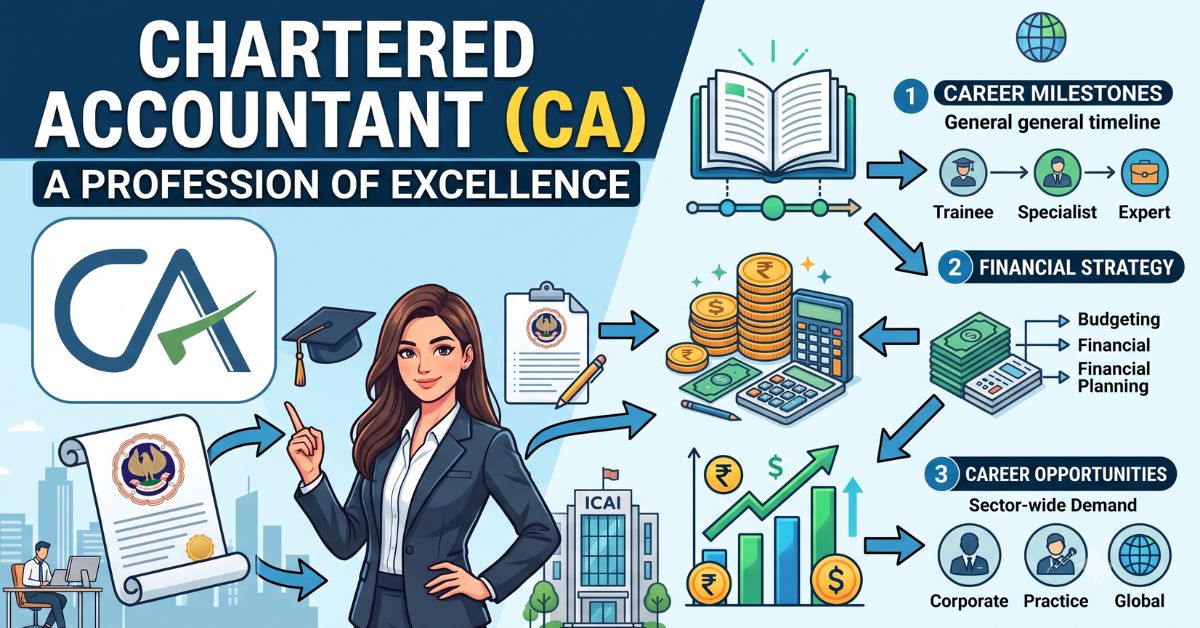
Searching on the web for “CA full form”? Well, you are likely interested in pursuing a lucrative career path in commerce. The full form of CA is Chartered Accountant, which is regulated by ICAI.
CA or Chartered Accountant is a professional qualification that indicates the expertise of an individual in auditing, taxation, accounting, finance, and business advisory. It is a highly valued profession and is in demand in industries.
If you are a student who is planning to start your CA journey, then understanding CA in depth is a vital step. Here is a guide helping you learn about CA course structure, fees, duration, eligibility, and career scope as per the latest updates under the ICAI New Scheme. So, let’s get started:
As you already know, the CA full form is Chartered Accountant, and it is regarded as one of the most respected professional qualifications on a global scale. The qualification indicates expertise in taxation, finance, auditing, accounting, and business advisory.
ICAI is a statutory body that was established under the Chartered Accountants Act, 1949. It is responsible for regulating the Chartered Accountant course in India.
CAs are responsible for helping businesses in managing their financial records, conducting audits, ensuring overall legal compliance, tax planning, and also providing support in making strategic financial decisions for the company or entity. The demand for such professionals is quite high globally.
Wondering what the ICAI full form is? Well, it stands for the Institute of Chartered Accountants of India, which was established in 1949. Its role is to regulate the Chartered Accountancy profession in India.
ICAI is responsible for conducting examinations, designing the curriculum, managing the practical training Articleship), and lastly awarding the CA designation. As per the ICAI New Scheme, the course has been updated with:
Wondering if there are different levels that you need to clear to become a CA? What is the CA course structure? It is a course that combines more practical as well as theoretical knowledge to ensure that candidates develop real-world expertise and skills.
Let’s know more with the help of the table below:
Level | Papers | Duration |
CA Foundation | 4 | Minimum 4 Months |
CA Intermediate | 6 | Minimum 8 Months |
Articleship | Practical Training | 2 Years |
SPOM | Modules A–D | Self-paced |
CA Final | 6 | After Articleship |
You can Read Also: Highest Paying Jobs in India
So, what’s the CA course duration? How many years does it take to complete it? Well, it depends on the entry route and the number of attempts that you would need to clear each level.
Entry Route | Minimum Duration |
After Class 12 | Around 4 Years |
Direct Entry (Graduates) | Around 3–3.5 Years |
With Multiple Attempts | 5–6 Years |
As per the ICAI New Scheme, the three-year Articleship has now been reduced to 2 years, which can help candidates qualify earlier while still gaining the right expertise and practical exposure.
Planning to start preparing for CA, but wondering about CA eligibility criteria? Students who aspire to become a CA can pursue the career through the Foundation route. One can register at the Foundation level after completing Class 12 or go for the Direct Entry route after completing their graduation.
Entry Level | Qualification | Minimum Requirement |
Foundation Route | Passed Class 12 | Eligible to appear after registration |
Direct Entry (Commerce) | Graduation | Minimum 55% |
Direct Entry (Non-Commerce) | Graduation | Minimum 60% |
Age Limit | — | No age restriction |
Students who want to start early and register for the Foundation course after completing class, 10th appear in the examination after clearing Class 12.
Is CA an expensive course? Well, it depends upon whether you only go for ICAI registration or also join an institute or coaching classes for the preparation. Let’s know more about it with the help of a table:
ICAI Registration & Examination Fees:
Level | Approx. Fee |
Foundation | INR 9,000 |
Intermediate | INR 23,000 |
Final | INR 39,000 |
Estimated Overall Cost:
Category | Approx. Cost |
ICAI Fees Only | INR 85,000–INR 1,00,000 |
With Coaching | INR 2–4 Lakhs |
The ICAI fee structure is relatively affordable in comparison to other professional courses. However, the coaching costs may vary depending on the institute you choose. Apart from that, you may need to invest in high-quality mock tests and study material in order to get desired results in the exam.
Now that you aspire to become a CA, you are probably wondering how to become a Chartered Accountant after 12th. Let’s know in detail about the process of becoming a CA with a step-by-step roadmap here:
Is it a lucrative career? Will I get a high salary? What is CA salary in India? These are some common questions that usually come to mind for students preparing for CA. With rising demand, CAs earn high salaries across industries.
However, the salary may differ based on location, skills, experience, employer, and specialisation. Apart from that, students who get hired through ICAI campus placements, MNCs, or Big 4 firms are likely to get higher salary packages comparatively. Let’s take a glimpse at how CA salary differ here:
Salary by Experience
Experience | Average Salary |
Fresher | INR 9–14 LPA |
3–5 Years | INR 15–25 LPA |
10+ Years | INR 30 LPA and above |
Salary by City
City | Average Salary |
Mumbai | INR 10–16 LPA |
Delhi NCR | INR 9–15 LPA |
Bengaluru | INR 10–16 LPA |
Chennai | INR 8–14 LPA |
Tier-2 Cities | INR 7–12 LPA |
Salary by Sector
Sector | Average Salary |
Big 4 Firms | INR 10–16 LPA |
MNCs | INR 9–15 LPA |
Banking & Financial Services | INR 8–14 LPA |
Government/PSUs | As per government pay scales |
Independent Practice | Income as per clients |
Kindly note that the salary figures mentioned here are based on aggregated placement trends and industry salary reports. The mentioned salary figure may change as per location, employer, role, and other factors.
You can Read Also: Chartered Accountant Salary in India 2026, Complete Guide
What are career opportunities for a Chartered Accountant? Can they build a career in both public and private sectors? Yes, after becoming a CA, one can build a sound career as it opens doors to several leadership roles in consulting, auditing, finance, and taxation.
Some of the top career options one can choose after qualifying as a CA include:
After gaining expertise and experience, CAs can also establish their own firms. On the other hand, many opt to accept the job roles of finance heads and Chief Financial Officers (CFOs) after gaining experience in the industry.
Wondering if CA is the right choice for you? Between so many other options available, it can become difficult to choose the right path. CA vs CMA vs CS vs ACCA- which should you choose? If that’s what you are thinking, then here is what it can help you understand difference between each career path, helping you decide the right one:
Factor | CA | CMA | CS | ACCA |
Full Form | Chartered Accountant | Cost & Management Accountant | Company Secretary | Association of Chartered Certified Accountants |
Regulator | ICAI | ICMAI | ICSI | ACCA (UK) |
Focus | Accounting, Audit & Taxation | Cost & Management Accounting | Corporate Law & Compliance | Global Accounting & Finance |
Duration | Around 4 Years | 3–4 Years | 3–4 Years | 2–3 Years |
Average Fresher Salary | INR 9–14 LPA | INR 6–10 LPA | INR 6–10 LPA | INR 8–15 LPA |
Best For | Finance & Audit Careers | Costing & Manufacturing | Corporate Governance | International Careers |
You can Read Also: CA vs CMA: Which is the Right Career Path for You?
With so many career options out there, is CA worth it in 2026? This is a question that is definitely crossing your mind. Well, if you are thinking so, then yes, Chartered Accountancy is definitely a lucrative career and one of the most respected professional qualifications in India.
If you’re planning to pursue this career path, the added advantage is that, as per the updated ICAI New Scheme, the articleship period has been reduced to 2 years instead of three years. It will help students to qualify faster while gaining the right expertise and practical exposure. Let’s know in detail about the pros and cons:
Pros
Cons
Now that you know all about the course from CA full form to career scopes, it is time for you to start your journey of becoming a CA. With the help of the new ICAI Scheme, completing the course has also become more accessible.
Whether you are someone who has just completed their class 12th or a graduate, starting your journey to become a CA after understanding the eligibility, fees, salary, course structure, CA exam pattern 2026, and more is quite essential to make an informed decision for your career.
If you want to know more about the course, you can read detailed guides on CA Foundation, Intermediate, and Final Levels or reach out to our expert team at Gyan Sagar Classes to help you build a roadmap to achieve career success. Reach out to us now!
CA full form is Chartered Accountant. It is a professional qualification that is regulated by ICAI.
ICAI full form is the Institute of Chartered Accountants of India. It is a statutory body that conducts CA examinations and regulates the profession.
The overall CA course duration in 2026 is a minimum of four years after the student has completed Class 12. The overall duration depends upon the exam attempts.
The total CA course fee is approximately INR 85,000–INR 1,00,000. However, the overall cost of the course depends upon the type of institute you choose.
The average CA salary in India for freshers is INR 9 to 14 LPA. However, the salary increases as per the experience, specialisation, and several other factors.
Both the courses are quite challenging; however, CA is considered a bit harder because of the practical training requirement, extensive syllabus and high competitive rates.
No, there is no age limit for registering for CA.
Yes, any candidate who has completed graduation and meets the required eligibility criteria can take the Direct Entry Route, which doesn’t require the candidate to enrol in the Foundation level.
No, it is a professional qualification, not a government job. CAs can work in government departments, regulatory bodies and PSUs.
No, maths is not compulsory for CA. Students with science, commerce, and arts backgrounds can easily register for the CA course if they meet the eligibility criteria.
Get Admission Now

If you are pursuing CMA Foundation, CMA Intermediate, or CMA Final, staying updated with the latest ICMAI notifications is essential. Recently, the Institute of Cost

If you are a CMA aspirant, then you are properly confused about a lot of things such as Exemption, Carry Forward, and Pass Criteria in

Already completed your B.Com and wondering what’s next? Choosing the best course after B.Com is quite essential as it shapes the next 10 years of

Is salary growth your real goal? CMA is the path you need to invest in. How much is the CMA salary in India? Well, let’s
Get Admission Now